Understanding Chronic Pain: What It Is and Why It's Different
Chronic pain outlasts the injury that caused it because something has changed in the nervous system itself — and treating it like a lingering symptom is why so many treatments fail.
Understanding Chronic Pain: What It Is and Why It's Different
By H. Rand Scott, MD — Medical Director, Newport Pain Management Reviewed and updated August 2026
Pain is a personal experience. Despite all our imaging technology and laboratory tests, there is still no machine that can measure directly how much pain someone is in. And the amount of tissue damage isn't a reliable guide either — the same injury can cause very different levels of pain in different people, or in the same person at different times. Some people experience severe pain with no physical problem that can be identified. Others walk around with clear damage and report no pain at all.
Understanding why is the first step toward treating it.
The old view of pain — and why it doesn't hold up
Stub your toe and it hurts almost immediately. Stub it harder and it hurts more. The obvious model: pain is the direct result of signals traveling from an injury site to the brain, in proportion to how much damage was done.
That common-sense view dominated medicine for a long time. It doesn't survive contact with reality:
- A soldier with a shattered leg can be unaware of pain in the middle of a firefight — and only feel it hours later, when the danger passes.
- A football player can finish a game on a torn ligament and only notice it in the locker room.
- Two patients with identical disc herniations on MRI can present with wildly different pain — one debilitated, the other functional.
- Cutting nerves that carry pain signals to the brain sometimes doesn't relieve pain, and can sometimes make it worse.
Something more complicated is going on. Understanding what has changed how modern pain medicine is practiced.
From gate control to modern neuroscience
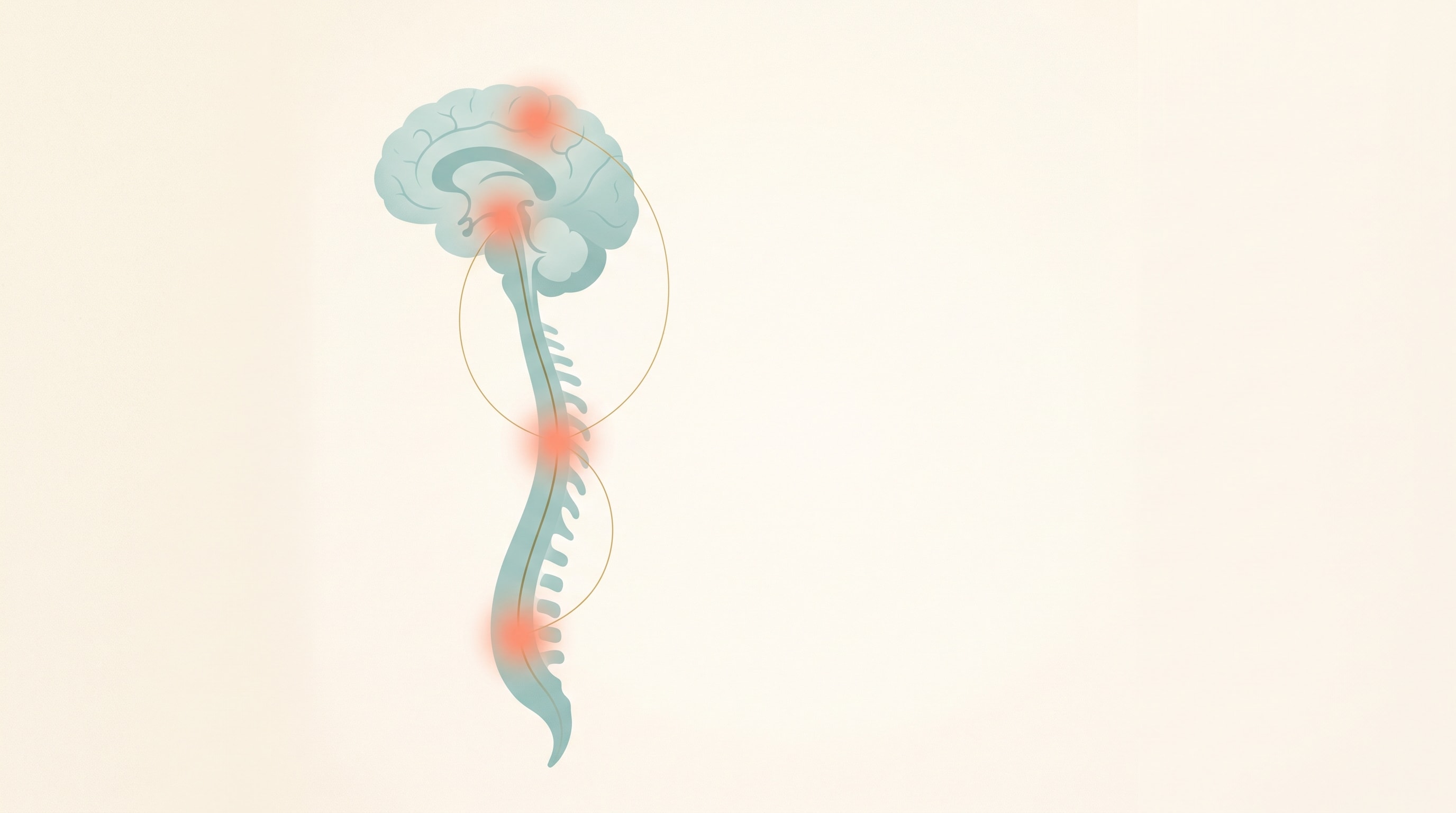
In 1965 Ronald Melzack and Patrick Wall described the gate-control theory of pain. Their central insight: the brain isn't a passive receiver of pain signals. It sends its own signals down the spinal cord that can open or close a "gate" — dampening or amplifying pain signals coming up. That was the first serious scientific model showing why mental, emotional, and behavioral factors can genuinely change how much pain a person feels.
Since then, the picture has grown considerably. Modern pain neuroscience recognizes three important expansions on the original gate-control idea:
- Central sensitization. When pain signals fire long enough or intensely enough, the spinal cord and brain undergo real, measurable changes — nerve cells become hypersensitive, signals get amplified, and inputs that were once neutral (light touch, temperature change) start being interpreted as pain. This is not imagination. It is the nervous system rewiring itself around chronic pain.
- The pain neuromatrix. Pain is now understood as the output of a distributed network in the brain — sensory, emotional, memory, and evaluative circuits all contributing. This is why the same tissue damage can produce different pain in different people, and why treatments that target any of those circuits can lower pain intensity.
- The biopsychosocial model. Effective chronic pain treatment addresses the biology (tissue, nerves, medications, procedures), the psychology (mood, stress, coping, sleep), and the social context (relationships, work, meaningful activity) at the same time. Treating any one of these alone tends to fail.
This isn't a philosophical position. It's what the evidence supports, and it's why serious pain programs today are structured the way they are.
Acute pain vs. chronic pain
The two are handled very differently in medicine, and understanding the distinction is essential.
Acute pain is recent and time-limited. A broken bone, a kidney stone, a burn, pain after surgery — the pain has a clear cause, and it fades as the tissue heals. Medicine is well set up to handle it: a patient enters the system with a symptom, the doctor identifies what's causing it, the underlying problem is treated, and the pain resolves. The patient's role is relatively passive.
Chronic pain is ongoing pain that has outlasted the normal healing window. Sometimes there is no clear diagnosis. Sometimes there is a clear cause but no cure available. Either way, the emphasis has to change — from finding a diagnosis and fixing it, to reducing pain, restoring function, and minimizing the damage chronic pain does to the rest of a person's life.
This is a critical shift. With chronic pain, the patient's role changes from passive to active. Pain is no longer just a symptom of some other problem — the pain itself has become the problem, and treating it well requires the patient's engagement in ways that acute care doesn't.
Current terminology from the International Classification of Diseases (ICD-11) distinguishes chronic secondary pain (pain caused by an identifiable ongoing condition, such as cancer or arthritis) from chronic primary pain (pain that persists as a condition in its own right, such as fibromyalgia or many low back pain syndromes).
What chronic pain does to a person
When pain first shows up, most people rely on the medical system to fix it. When it doesn't get fixed, a predictable pattern often follows: endless doctor visits, more tests, riskier procedures, more medications, and increasing frustration when nothing works.
Meanwhile, the natural instinct to protect the painful area — reasonable in an acute injury — becomes destructive over months and years. Muscle strength decreases, range of motion narrows, and general fitness declines. Sleep gets disrupted, which makes pain harder to tolerate the next day. Meaningful activities drop off. Social contact shrinks. Depression develops in a high percentage of patients with chronic pain — not because they're weak, but because chronic pain is genuinely depressing, and the biology of pain and depression overlap.
The relationship with medical care can sour too. Patients get frustrated with doctors who can't help. Doctors get frustrated with pain that doesn't respond. Both sides lose trust. Occasionally a doctor will suggest the pain is psychological — which is almost always the wrong framing and almost always damages the therapeutic relationship further.
This cascade is common. It is also reversible.
What actually helps
Managing chronic pain is a coordinated effort across several fronts. None of these alone tends to be enough. Together they consistently reduce pain and improve quality of life.
Meaningful activity. People with chronic pain often keep doing chores while giving up the activities that make their lives feel worthwhile. That has it backwards. Getting the meaningful and enjoyable activities back into the schedule — even in modified form — is one of the most reliable ways to reduce the grip pain has on daily life.
Relationships. Social contact and honest communication push back against the isolation and despair that chronic pain feeds. Family members often want to help but don't know how. Talking openly about what actually helps — and what doesn't — protects both sides of the relationship.
Physical reconditioning. Regular exercise is important when we're well. It's critical when we're not. A person with a chronic condition should be in the best physical shape possible for their circumstances. Physical therapists prescribe rehabilitation exercises to restore strength, mobility, and range of motion — and when done consistently, these can reverse the downward course that so many patients fear is permanent. Pacing is essential: doing too much on good days and paying for it for the next three is one of the most common patterns in the clinic.
Depression and stress. Depression from chronic pain is legitimate depression. It responds to treatment, and treating it lowers the pain a person actually feels — not because the depression was the pain in disguise, but because depression and pain share neurochemistry, and improving one improves the other.
Stress works the same way. Under stress, muscles tighten, the nervous system becomes more reactive, and pain signals amplify. Stress management — regular exercise, meaningful activity, direct communication, cognitive-behavioral techniques, biofeedback, relaxation training, and where appropriate, medication — is not a soft add-on. It is part of pain treatment.
The role of interventional pain treatment
None of the above replaces the medical and interventional side of chronic pain care. Modern interventional pain management includes targeted injections, nerve blocks, radiofrequency ablation of specific pain-generating nerves, spinal cord and peripheral nerve stimulation, and ketamine infusions for certain refractory conditions. The right choice depends on where the pain is actually coming from and why it's persisting — which is what a careful pain specialist evaluation is designed to figure out.
Chronic pain is a serious problem. It is also, in most cases, a treatable one — when the treatment plan addresses the physical, psychological, and social dimensions together instead of chasing any one of them in isolation. To request an evaluation, call Newport Pain Management at (949) 759-8400.
This article is for general education and is not a substitute for individual medical advice.
Medical disclaimer: This post is for general education and is not a substitute for individual medical advice. Always consult your physician about your specific condition and before making any changes to your medications.
Explore Topics
Written by
H. Rand Scott, MD
Medical Director of Newport Pain Management in Newport Beach since 1996. Board-certified anesthesiologist with subspecialty fellowship training in pain management. Former Penn State football player, 1982 national championship team. Sports medicine clinical training on the Penn State football medical staff. Twice named Orange County Medical Association Physician of Excellence.