Chronic Pain FAQs: A Pain Specialist Answers the Common Questions
The questions we hear most often from new chronic pain patients — from why me to when will it stop — answered by a specialist with three decades in the field.

Chronic Pain FAQs: A Pain Specialist Answers the Common Questions
By H. Rand Scott, MD — Medical Director, Newport Pain Management Reviewed and updated August 2026
Chronic pain affects nearly one in four American adults. According to the CDC's most recent National Health Interview Survey, 24.3% of US adults reported chronic pain in 2023, and 8.5% reported pain severe enough to regularly limit daily life or work. These are the highest figures the survey has ever recorded, and they've been climbing every year the survey has been done.
This FAQ collects the questions patients most commonly bring to a pain specialist — what chronic pain is, how it differs from acute pain, what treatments are available today, and how to work effectively with your medical team.
What chronic pain is, and why it's different
Is all pain the same?
No. Two very different things share the same word.
Think of the worst pain you can remember — a corneal scratch, a kidney stone, childbirth. In each of those, pain flared up in response to a known cause. With treatment or with the body's own healing, you got better and the pain went away. That's acute pain: a normal signal from the nervous system alerting you to injury and the need to take care of yourself.
Chronic pain is different. Pain signals keep firing in the nervous system for weeks, months, sometimes years. There may have been an initial injury you've long since recovered from. There may be an ongoing condition — arthritis, diabetes, cancer, a compressed nerve. Some people have chronic pain with no identifiable injury at all. The pain is real regardless. Emily Dickinson knew the state before medicine had names for it:
Pain — has an Element of Blank — It cannot recollect When it begun — or if there were A time when it was not —
What's the difference between acute and chronic pain?
Acute pain is temporary. It's tied directly to the physical sensation of tissue damage and generally subsides as normal healing occurs. A burn, a fracture, an overused muscle, pain after surgery — all acute. Cancer pain from active tumor growth can persist for a long time but is still technically acute in this framework, because it comes from ongoing tissue damage.
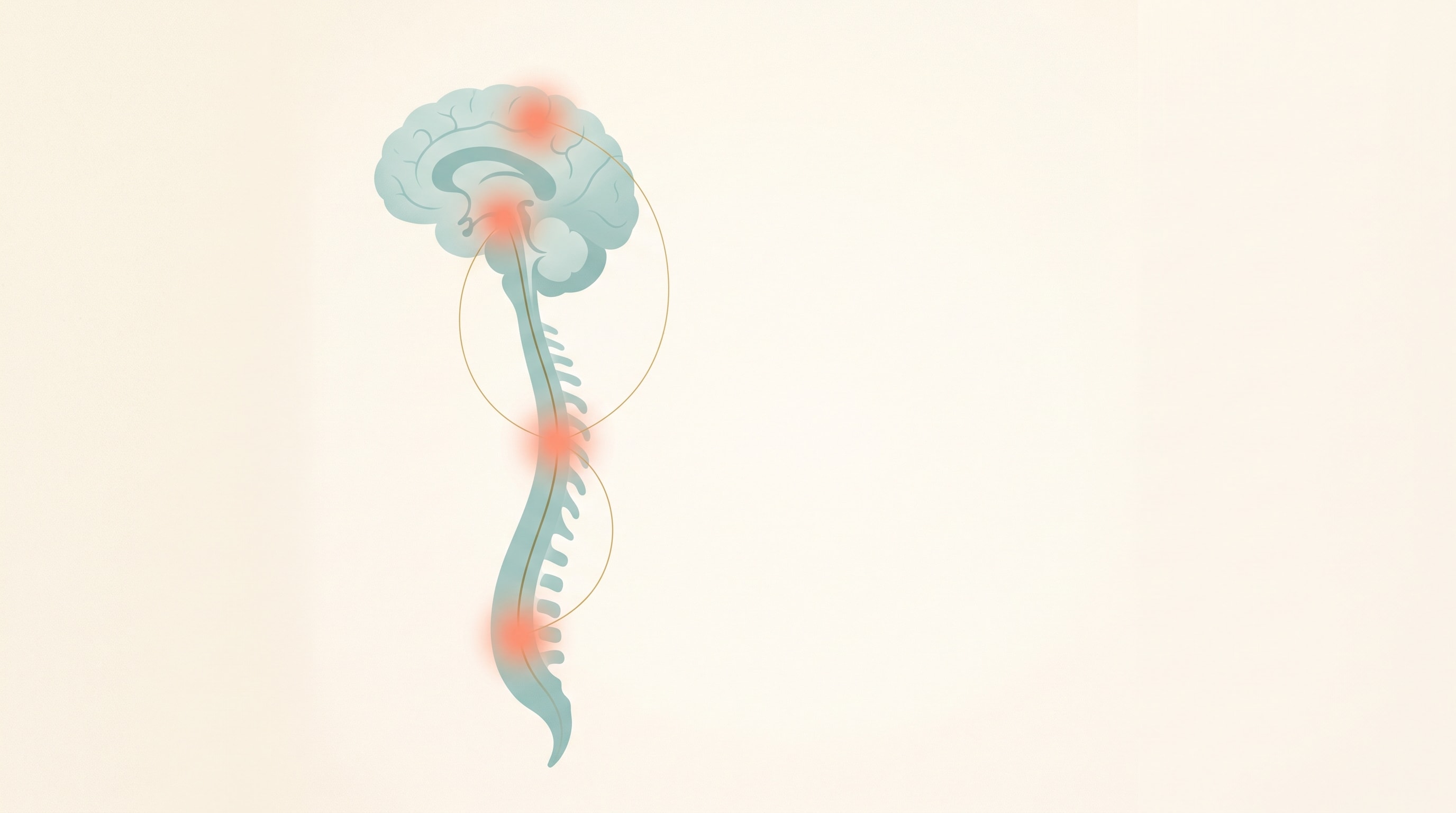
Chronic pain lingers well past the normal healing window. Some chronic pain comes from actual damage to the nerve fibers themselves — this is neuropathic pain. Other chronic pain develops when the nervous system itself changes: the spinal cord and brain become more sensitive to pain signals, and inputs that shouldn't hurt begin to hurt. This is called central sensitization, and it's one of the reasons chronic pain can persist after the original injury has healed.
The World Health Organization now separates chronic pain into two categories in ICD-11:
- Chronic secondary pain — pain caused by an identifiable ongoing condition such as cancer, arthritis, or nerve injury.
- Chronic primary pain — pain that has become a condition in its own right and is no longer serving a useful protective function. Fibromyalgia and many forms of persistent low back pain fall in this category.
The distinction matters because it shapes what treatment is likely to help.
What can happen to a person with chronic pain?
Pain of any real intensity, sustained over time, tends to overwhelm everything else. People often can't work. Appetite falls off. Physical activity becomes exhausting and can aggravate the pain, which makes it feel like activity itself is the enemy. A vicious circle sets in: preoccupation with pain leads to irritability and depression, sleep gets disrupted, the next day's fatigue amplifies the pain, and the cycle tightens.
Specialists sometimes call this the terrible triad — suffering, sleeplessness, and sadness. It's as hard on the family as on the patient. And the urge to make it stop can push some patients into repeated procedures, medication escalation, or the arms of practitioners who promise quick and permanent cures they can't actually deliver.
The good news, which the rest of this FAQ works through: this cycle is treatable, even when the underlying condition can't be cured.
Why does it seem like more people have chronic pain today?
Because more people do. The CDC data shows a real upward trend — 20.4% of US adults reported chronic pain in 2016, 20.9% in 2021, and 24.3% in 2023. Multiple factors contribute: an aging population, higher rates of obesity and diabetes (both of which drive musculoskeletal and nerve pain), longer survival after injury and cancer, and better recognition of chronic pain as a legitimate medical condition rather than a moral failing.
How pain is evaluated and why it varies
How do doctors evaluate pain?
Pain is subjective, but it can still be measured. Pain specialists use validated rating scales, structured questionnaires, and pain diagrams so patients can describe where and how it hurts. A careful history and physical examination — often more informative than any imaging — locates the likely pain generator.
When simpler evaluations don't give a clear answer, imaging can help: X-ray, CT, MRI, ultrasound, and bone scans can reveal problems in bones, muscles, joints, discs, and soft tissue. Electrodiagnostic studies (EMG and nerve conduction) can assess nerve function directly. And diagnostic nerve blocks — small, targeted injections of local anesthetic — can confirm whether a specific structure is generating the pain before any longer-term treatment is planned.
For complex cases, a team approach involving anesthesiology, neurology, psychology, rheumatology, physiatry, and physical therapy often works better than any one specialty alone.
Why do people react so differently to pain?
Two patients with identical injuries can have very different pain experiences. Several factors are always in play:
- Physical factors: the sensitivity of your nervous system, prior injuries at the same site, and the specifics of the current problem.
- Emotional factors: fear, anxiety, depression, and prior pain experiences all amplify the pain you feel.
- Social and cultural factors: how the people around you respond to pain, and the messages you absorbed about pain growing up.
One of the clearest illustrations of this comes from wartime observations. Combat veterans with severe wounds often require less pain relief than civilians with matched injuries. The context — survival, escape from a life-threatening situation — genuinely changes how the nervous system processes the pain signal. None of this makes pain less real. It explains why pain management has to address more than just the tissue.
If I have a physical problem, why do I hurt more when I'm stressed?
Because pain isn't just a signal traveling up your spinal cord. When a pain signal reaches your brain, it passes through a filter shaped by your emotional state, past pain experiences, current outlook, sleep, and stress level. Anxiety amplifies pain. So does depression. So does poor sleep.
This isn't a soft observation — it's how the nervous system is wired. Stress increases muscle tension, which puts added load on joints and connective tissues. It makes the nervous system more reactive, which increases pain signals. And it feeds depression, which increases perceived pain intensity. Managing stress isn't optional in chronic pain treatment. It's part of the treatment.
What is the placebo effect?
The placebo effect is real, measurable, and neurochemical — not a sign that the pain was imagined. In carefully designed studies, a substantial fraction of patients (in some trials, about a third) report meaningful pain relief from an inactive treatment. Follow-up work has shown that this relief is often blocked by naloxone, a drug that blocks the body's own opioid receptors — strong evidence that the placebo effect works, at least in part, by activating the brain's own pain-control systems.
That's a useful thing to know. It means the body has genuine internal capacity to modulate pain, and that mental and emotional context can unlock it. Modern pain treatment tries to work with those systems rather than dismiss them.
What kinds of pain do specialists treat?
Chronic pain covers a wide range of conditions. The most common that pain specialists see:
- Headache and migraine. Roughly 40 million Americans have recurrent headache disorders. Migraine alone accounts for tens of millions of lost workdays each year.
- Low back and neck pain. Low back pain is one of the leading causes of disability worldwide, and a very common reason for pain specialist referral.
- Cancer pain. Most patients with intermediate or advanced cancer experience moderate to severe pain during their course. Modern palliative approaches include a full range of interventional and pharmacologic options.
- Arthritis pain. More than 50 million American adults have doctor-diagnosed arthritis. Osteoarthritis is the most common form; rheumatoid arthritis and other inflammatory arthritides require different treatment.
- Neuropathic pain. Nerve pain from diabetes, shingles (postherpetic neuralgia), trigeminal neuralgia, spinal nerve root compression, complex regional pain syndrome, and other conditions where the nerves themselves are damaged or sensitized.
- Post-surgical pain. Pain persisting past the normal healing window after surgery, including chronic post-thoracotomy, post-mastectomy, and post-hernia repair pain.
- Central pain and chronic primary pain syndromes. Fibromyalgia, chronic pelvic pain, and other conditions in which pain has become the primary problem rather than a signal of ongoing tissue damage.
Medications for chronic pain
What about anti-inflammatories like aspirin and ibuprofen?
When your doctor tells you to take an anti-inflammatory and stay off your feet for a couple of days, it can feel like the pain is being dismissed. It isn't. Aspirin, ibuprofen, naproxen, and related drugs (called NSAIDs) work at the earliest point in the pain pathway — the site of the injury itself. They block the production of prostaglandins, chemicals that sensitize nerve endings and drive the pain, heat, redness, and swelling of inflammation.
For many conditions, NSAIDs remain the most useful first-line medication. Long-term use has its own risks (gastric ulcers, kidney effects, cardiovascular concerns), so a specialist will help you weigh those against benefits and choose the right drug and dose for your situation.
Some patients develop a state called hyperalgesia — nerves become so sensitized that even a light breeze can hurt. Interrupting this cycle early is one reason effective acute pain management matters.
How do endorphins fit in?
Endorphins are the body's own opioid-like painkillers, produced in the nervous system in response to injury, stress, exercise, and other triggers. Chronic pain patients often have lower-than-normal endorphin levels in their spinal fluid — which is one reason chronic pain is hard to override with willpower alone.
Simply raising endorphin levels artificially has proven harder than it sounds. Endorphins have many other roles in the nervous system, and (like opioid medications) they carry a tolerance and dependence risk. So while the endorphin system remains an important target for research, current treatment tries to work with it indirectly — through exercise, sleep, stress management, and specific medications and procedures that engage the same pathways.
Where do opioids fit in modern pain treatment?
Opioids remain an important tool for acute pain, cancer pain, and end-of-life care. Their role in long-term treatment of chronic non-cancer pain is much more limited than it was two decades ago.
The reason: while opioids often provide short-term relief, long-term use in chronic non-cancer pain frequently produces tolerance (needing more drug for the same effect), physical dependence, and — in a subset of patients — opioid-induced hyperalgesia, in which the medication itself begins to amplify pain. For most chronic non-cancer pain, the balance of evidence favors non-opioid medications, interventional procedures, and non-medication approaches for long-term control.
When opioids are used for chronic pain, they should be part of a documented, monitored plan with clear goals — not open-ended prescribing.
What about antidepressants for chronic pain?
Certain antidepressants have direct pain-relieving effects that are independent of their effect on mood. This isn't the doctor implying the pain is in your head. These drugs act on the same neurotransmitters (serotonin and norepinephrine) that the body uses to dampen pain signals in the spinal cord.
Two classes are used most often:
- Tricyclic antidepressants (amitriptyline, nortriptyline) — long-established for neuropathic pain and chronic headache.
- Serotonin-norepinephrine reuptake inhibitors (duloxetine, venlafaxine) — FDA-approved for several chronic pain indications including diabetic neuropathy, fibromyalgia, and chronic musculoskeletal pain.
Doses used for pain are often lower than doses used for depression, and the pain benefit doesn't require treating depression at all.
What about antiseizure medications (gabapentin, pregabalin)?
Antiseizure medications — often called antiepileptic or anticonvulsant drugs — have become a mainstay of neuropathic pain treatment. The rationale is that damaged nerves generate abnormal electrical discharges, similar in some ways to what happens in an epileptic seizure. Drugs that quiet excessive nerve discharge can quiet the distress signals of injured nerves.
Gabapentin and pregabalin are the most commonly used. They work well for diabetic neuropathy, postherpetic neuralgia (shingles pain), and some forms of nerve root compression. Older antiseizure drugs like carbamazepine remain the first-line treatment for trigeminal neuralgia.
What about tramadol?
Tramadol is a synthetic analgesic that combines weak opioid activity with effects on the serotonin and norepinephrine systems. It's used for both acute and chronic pain and has a different side-effect profile than traditional opioids, though it still carries dependence risk and interacts with many other medications. Common side effects include dizziness, drowsiness, nausea, constipation, and sweating.
What about migraine-specific medications?
Migraine treatment has advanced considerably in the past several years. Options now include:
- Triptans (sumatriptan, rizatriptan, and others) — narrow blood vessels and abort a developing migraine when taken early.
- Gepants (ubrogepant, rimegepant, atogepant) — a newer class that blocks calcitonin gene-related peptide (CGRP) receptors. Used for both acute treatment and prevention. They don't constrict blood vessels, which makes them safer for patients with cardiovascular disease.
- CGRP monoclonal antibodies (erenumab, fremanezumab, galcanezumab, eptinezumab) — injectable preventive treatments for chronic and episodic migraine.
Which of these fits depends on migraine pattern, frequency, other medical conditions, and response to prior treatment.
How does capsaicin work?
Capsaicin is derived from chili peppers, and it's the same chemical that makes them hot. Applied to the skin as a cream or high-concentration patch, it depletes substance P — a chemical involved in pain signaling — from nerve endings in the treated area. Repeated application can meaningfully reduce pain from postherpetic neuralgia, diabetic neuropathy, and some forms of osteoarthritis pain. Expect an initial burning sensation where it's applied, and expect to need repeated use for sustained benefit.
Interventional pain treatments
What is interventional pain management?
Interventional pain management uses targeted procedures — most of them image-guided injections or minor procedures done in a specialized clinic — to treat pain at its source, or to interrupt the pain pathway between the source and the brain. Most of these procedures are outpatient, take under an hour, and don't require general anesthesia.
Interventional pain is where much of the meaningful progress in chronic pain treatment has happened in the past two decades. Newport Pain Management is an interventional practice, so this is where our clinical focus lives.
What are nerve blocks?
A nerve block is a targeted injection of local anesthetic — sometimes combined with a small dose of steroid — near a specific nerve, joint, or spinal structure. Nerve blocks serve two purposes:
- Diagnostic. If a targeted block relieves the pain, that confirms the injected structure is generating the pain, and identifies it as a target for longer-term treatment.
- Therapeutic. Many nerve blocks provide weeks to months of pain relief, and repeated blocks can sometimes provide durable improvement.
Common examples include epidural steroid injections for radicular back and leg pain, medial branch blocks for facet joint pain, and sympathetic blocks for certain nerve pain syndromes.
What is radiofrequency ablation?
Radiofrequency ablation (RFA) uses a small needle-electrode, positioned under X-ray guidance, to deliver heat to a specific pain-carrying nerve. The heat disrupts the nerve's ability to transmit pain signals, without cutting anything or leaving a scar.
RFA is well-established for facet joint pain in the neck and back, for certain forms of sacroiliac joint pain, and for pain from knee and hip osteoarthritis in patients who aren't surgical candidates. Relief typically lasts six to twelve months and the procedure can be repeated. It's often preceded by diagnostic nerve blocks to confirm the target nerve is the right one.
What is spinal cord stimulation?
Spinal cord stimulation (SCS) uses a small implanted device to deliver mild electrical signals to the spinal cord, which interrupt or mask pain signals before they reach the brain. Modern SCS systems use sophisticated waveforms that can produce meaningful pain relief without the tingling sensation older devices caused.
SCS is used for chronic back and leg pain (particularly after failed back surgery), complex regional pain syndrome, painful diabetic neuropathy, and certain other neuropathic pain conditions. Before permanent implantation, patients typically undergo a temporary trial with an external device to confirm the therapy works for them.
What are ketamine infusions?
Ketamine is a medication with over fifty years of use in anesthesiology. At carefully controlled sub-anesthetic doses, given as an intravenous infusion, ketamine has emerged as a valuable option for certain refractory chronic pain conditions — particularly complex regional pain syndrome, some forms of neuropathic pain, and central sensitization syndromes that haven't responded to standard treatment.
Ketamine works differently from opioids and doesn't carry the same dependence profile. Infusion protocols vary by condition and require an appropriately trained team in a monitored setting. Newport Pain Management directs the KetaCure Ketamine Infusion Center for exactly this population of patients.
Non-medication approaches
How does electrical stimulation work?
Applying brief pulses of electricity to nerve endings under the skin is called TENS — transcutaneous electrical nerve stimulation. TENS units are small, wearable devices that can provide meaningful relief for some patients, particularly for musculoskeletal pain in areas of intact skin sensation. Both the frequency and voltage matter. The evidence for TENS in chronic pain is mixed but it's low-risk and worth a trial for many patients.
How does acupuncture work?
Acupuncture — the insertion of fine needles at selected points on the body — has been studied more rigorously in the past two decades than in the entire preceding century. Current evidence supports it for chronic low back pain, neck pain, tension headaches, migraine prevention, and knee osteoarthritis. The mechanism appears to involve activation of the body's own pain-modulation systems, including endorphin release and effects on descending pain-control pathways.
Acupuncture won't fix a structural problem, but it can be a useful adjunct in a broader pain management plan.
What psychological approaches actually help with pain?
The philosophy behind all of these approaches is the same: patients have real capacity to reduce their own pain, and specific techniques can unlock it. This isn't about pretending the pain isn't real. It's about training the same brain systems that unconsciously amplify pain to help dampen it instead.
- Cognitive-behavioral therapy for pain. The most extensively studied psychological approach to chronic pain. Targets the specific thought patterns and behaviors that amplify pain and disability.
- Relaxation training and meditation. Reduce muscle tension, lower nervous system reactivity, and reduce pain intensity in many patients.
- Biofeedback. Uses real-time feedback about body functions (muscle tension, heart rate, skin temperature) to help patients gain voluntary control. Especially useful in tension headache and some forms of back pain.
- Hypnosis. For patients who respond well to it, can meaningfully reduce pain intensity and the emotional suffering that accompanies pain.
- Family and couples work. Chronic pain places significant strain on relationships. Direct work with partners and family members often produces gains that individual work alone cannot.
Can physical therapy help?
For most chronic pain conditions, yes — often substantially. Fear of exercise is one of the most predictable patterns in chronic pain, and it's usually counterproductive. A well-designed program that starts gently and progresses gradually rarely causes injury and often reduces pain over time.
A good program includes stretching, targeted strengthening, and aerobic exercise (walking, swimming, or cycling are all reasonable starting points). For chronic back pain, muscle-strengthening exercises alone can sometimes provide enough relief to avoid surgery. Occupational therapy can help you rebuild capacity for tasks at home and work — often the most important measure of whether treatment is working.
Surgery for chronic pain
When is surgery an option?
Surgery for chronic pain has changed considerably. Historically, surgical approaches involved cutting pain-carrying nerve fibers directly. Those procedures are largely of historical interest now — they often destroyed other sensations, sometimes created new pain, and frequently provided only temporary relief.
Modern surgical approaches for chronic pain fall into a few categories:
- Structural surgery to remove a specific cause of pain — for example, decompressing a compressed nerve root, replacing an arthritic joint, or removing a tumor.
- Implant procedures that place devices for spinal cord stimulation, peripheral nerve stimulation, or intrathecal medication delivery. These are typically preceded by trials to confirm benefit before permanent placement.
- Microvascular decompression for trigeminal neuralgia, in which the surgeon places a small buffer between a blood vessel and the trigeminal nerve where they are inappropriately in contact.
The decision to operate always involves a careful weighing of what's likely to be gained against the risks of the specific procedure. A good pain specialist can help patients evaluate whether surgery is appropriate at all, and if so, which type.
Common chronic pain conditions and how they're treated today
Headache and migraine
The two most common types are tension-type headache (involving sustained contraction of head and neck muscles) and migraine (a distinct neurological condition involving throbbing pain, often on one side, sometimes with visual or sensory changes). Migraine has strong genetic components but many triggers.
Treatment has expanded significantly. Beyond conventional pain relievers, migraine treatment now includes triptans for acute attacks, gepants for both acute and preventive use, CGRP monoclonal antibodies as injectable prevention, and — for patients with chronic migraine — targeted onabotulinumtoxinA (Botox) injections in a specific pattern of head and neck sites. Tension headache often responds well to physical therapy, biofeedback, and stress-focused approaches.
Low back and neck pain
Most acute back pain resolves with a short period of activity modification, targeted exercise, and simple analgesics. When back pain persists, careful evaluation identifies whether the source is a compressed nerve root, arthritic facet joint, degenerated disc, sacroiliac joint, or something else. Modern interventional approaches — epidural steroid injections for radicular pain, medial branch blocks and RFA for facet-mediated pain, sacroiliac joint injections and stabilization for SI-joint pain — can provide significant relief without surgery for many patients.
Long-term muscle relaxants (particularly the older tranquilizer-type drugs) are generally not helpful for chronic back pain and can add to depression and fatigue.
Cancer pain
Cancer pain can come from tumor growth, from treatment (radiation, chemotherapy, surgery), or from the nerve damage these can cause. Modern cancer pain treatment uses a stepped approach that draws on the full range of medications, interventional procedures (nerve blocks, neurolysis for specific tumor-related pain, intrathecal drug delivery for refractory cases), and integrated palliative care. Effective cancer pain treatment is not just a comfort issue — good pain control improves function, mood, and often survival.
Arthritis pain
Osteoarthritis and inflammatory arthritis (rheumatoid arthritis, psoriatic arthritis, and others) are treated differently.
Osteoarthritis treatment includes NSAIDs, targeted joint injections (steroid or hyaluronic acid), physical therapy, weight management, and — for pain from knee and hip osteoarthritis in patients who aren't surgical candidates — genicular or geniculate nerve RFA. Joint replacement is highly effective when the joint is far enough gone.
Inflammatory arthritis has been revolutionized by biologic disease-modifying drugs (DMARDs) that target the specific immune pathways driving joint damage. Rheumatologist-directed treatment for the underlying disease usually reduces pain more effectively than any pain-directed treatment.
Nerve pain (neuropathic pain)
Nerve pain has traditionally been one of the hardest to treat. It responds poorly to conventional analgesics, and standard opioids often provide limited relief. Modern approaches use:
- Antiseizure medications (gabapentin, pregabalin, carbamazepine for trigeminal neuralgia).
- Certain antidepressants (tricyclics, SNRIs) at pain-effective doses.
- Topical treatments (lidocaine patches, high-concentration capsaicin) for localized nerve pain.
- Interventional procedures (specific nerve blocks, RFA of appropriate targets, spinal cord or peripheral nerve stimulation, and sympathetic blocks for certain nerve pain syndromes).
- Ketamine infusions for refractory neuropathic pain, particularly complex regional pain syndrome.
Phantom limb pain — pain perceived in a limb that is no longer there — is a distinct form of neuropathic pain that responds to a similar combination of approaches, along with specific rehabilitation techniques including mirror therapy.
Working with your pain specialist
What can I do to help my doctor help me?
Pain treatments work differently for different people. Even a well-chosen treatment sometimes doesn't provide the relief a patient needs, and course-correcting requires good information from the patient side.
The most useful things you can bring to your evaluation:
- A clear history of what has and hasn't worked. Which pain medications you've tried, at what doses, for how long, and how well.
- A current list of medications and supplements. Including over-the-counter products, herbal remedies, and vitamins. Some of these interact meaningfully with pain treatments.
- Allergies. Especially to medications, contrast agents, and adhesives (if you've had procedures).
- Prior imaging and reports. Bringing your own copies of MRIs, CT scans, EMGs, and prior specialist notes speeds up the evaluation considerably.
- Honest concerns and fears. Fear about medications, fear about procedures, fear about what the pain means — these matter for treatment planning and for informed consent. Your specialist can only address concerns they know about.
What's the bottom line?
Chronic pain is common, it's genuinely disabling, and it's more treatable now than at any prior point in medicine. The keys to good pain control are the same as they've always been: early treatment when the problem is still simple, careful evaluation to identify what's actually generating the pain, honest ongoing assessment of what's working, and clear communication between you and your medical team.
Pain is nearly universal. It doesn't have to define your life. To request an evaluation, call Newport Pain Management at (949) 759-8400.
This article is for general education and is not a substitute for individual medical advice.
Medical disclaimer: This post is for general education and is not a substitute for individual medical advice. Always consult your physician about your specific condition and before making any changes to your medications.
Explore Topics
Written by
H. Rand Scott, MD
Medical Director of Newport Pain Management in Newport Beach since 1996. Board-certified anesthesiologist with subspecialty fellowship training in pain management. Former Penn State football player, 1982 national championship team. Sports medicine clinical training on the Penn State football medical staff. Twice named Orange County Medical Association Physician of Excellence.