Referred Pain: Why the Site of Pain Isn't Always the Source
A shoulder ache from the heart, a jaw pain from a bad tooth, low back pain from a kidney — referred pain is one of medicine's most useful diagnostic puzzles. Here's how it works.
Referred Pain: Why the Site of Pain Isn't Always the Source
By H. Rand Scott, MD — Medical Director, Newport Pain Management Reviewed and updated August 2026
When something hurts, most people assume the problem is where they feel it. Often it isn't.
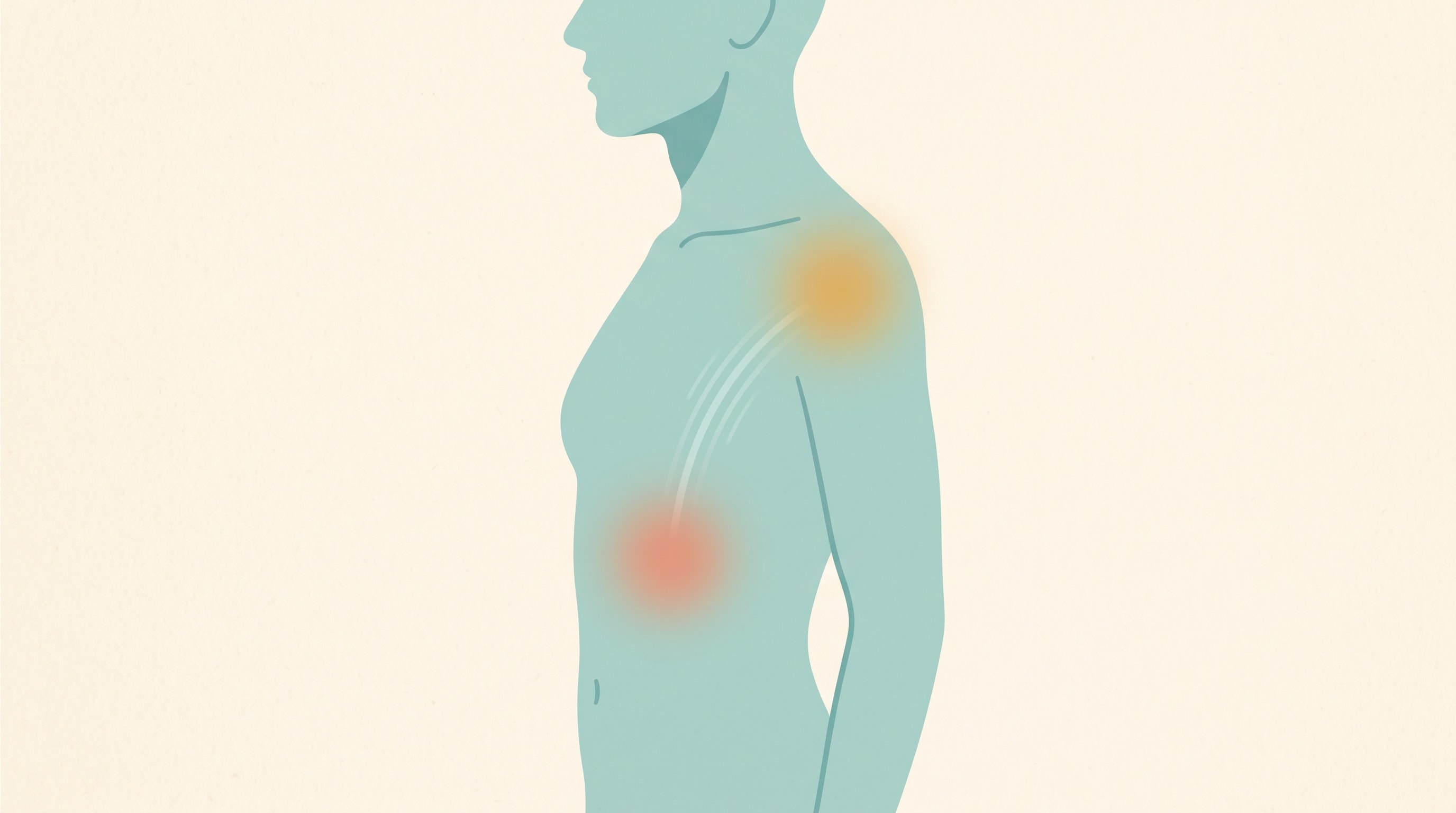
The pain of a heart attack is usually felt in the left shoulder and arm — not the chest wall over the heart itself. Hit your elbow on the "funny bone" and the pain shoots down into your forearm and hand, nowhere near the elbow. Bite into ice cream too fast and your forehead throbs, even though nothing is wrong with your forehead.
This is referred pain — pain felt at a site different from where the actual problem lives. Understanding it is one of the most useful things a patient can learn about their own body, because it explains why the wrong body part sometimes gets treated for months while the real source of the problem is missed.
How the spinal cord routes pain signals
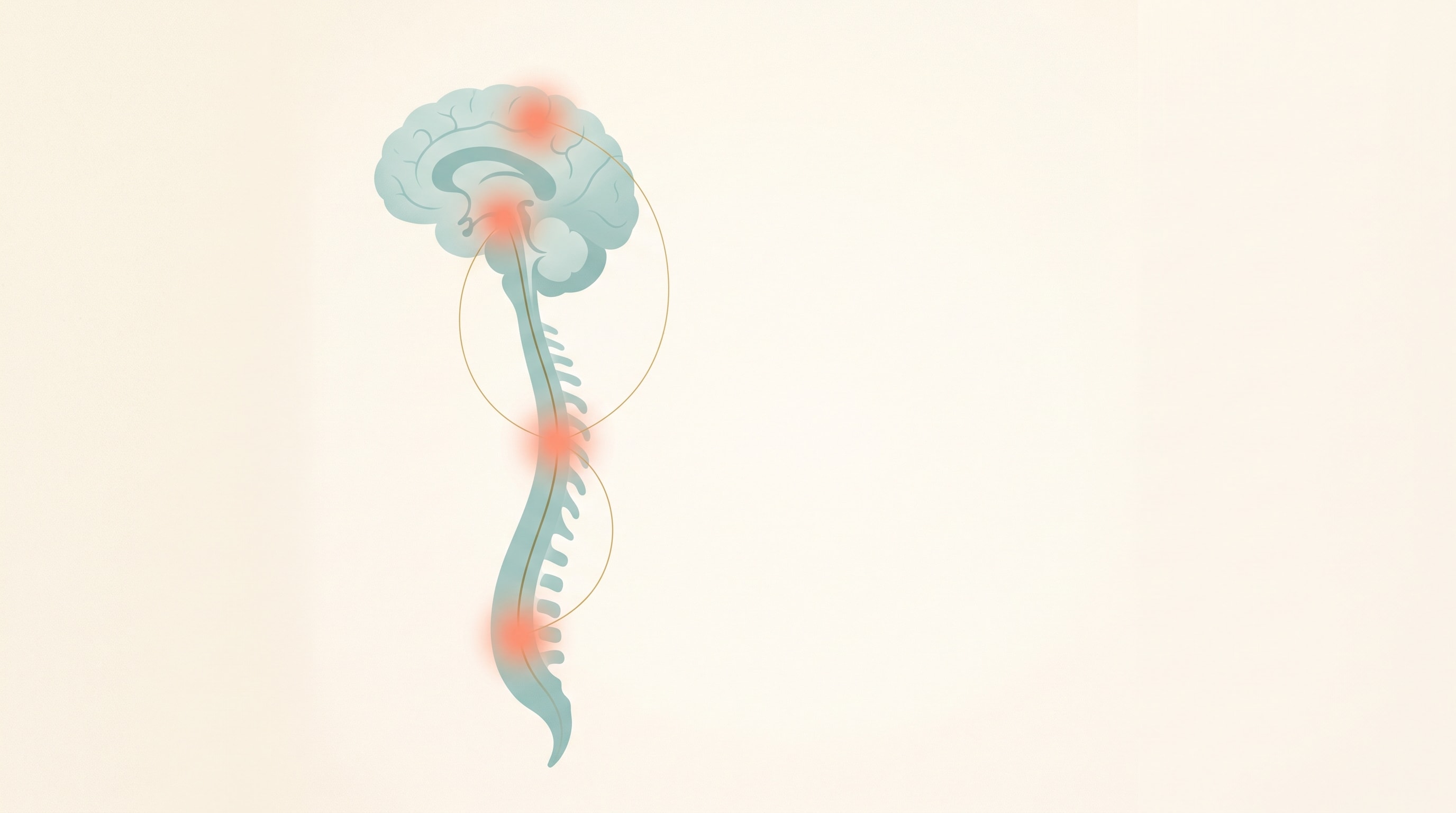
The spinal cord is the switchboard between the body and the brain. Sensory nerves (temperature, pain, touch) run up one set of pathways; motor nerves (movement) run down another. When you touch something hot, the signal travels this route:
- Heat sensors in the skin fire.
- The message travels through a peripheral nerve into the spinal cord.
- The spinal cord does two things at once:
- Reflex arc: it sends an immediate signal back to the hand to pull away — before the brain has even registered the burn.
- Cortical relay: it forwards the message up to the brain, which consciously perceives "hot."
The reflex is what protects tissue. The brain's job is to figure out where the signal came from and what to do about it. When that localization fails, you get referred pain.
How a problem in an organ can be felt on the skin
The nerve fibers that carry pain signals from internal organs (heart, gallbladder, appendix, diaphragm) share spinal cord neurons with fibers that carry pain from the skin over the same segmental level. When both feed into the same relay neuron, the brain can't tell which source lit it up. Because skin pain is far more common in daily life than organ pain, the brain's default guess is skin — even when the actual source is deep inside.
This is called the convergence-projection theory, and it's the best-supported explanation we have today. It's why:
- Heart attack pain is often felt in the left shoulder, arm, jaw, or upper back (cardiac and skin fibers converge at cervical and upper thoracic levels).
- Gallbladder disease can be felt in the right shoulder blade.
- Appendicitis often starts as vague pain around the belly button before localizing to the right lower quadrant.
- Diaphragm irritation shows up in the shoulder tip.
The clinical significance is straightforward: some of the most dangerous problems in medicine — heart attack, ruptured appendix, ectopic pregnancy — announce themselves through referred pain first. Dismissing "just a shoulder ache" or "just indigestion" is how these are missed.
How a problem in a nerve can be felt on the skin
Most pain nerves enter the spinal cord through the small spaces between vertebrae. Each spinal nerve serves a defined patch of skin, called a dermatome, named after the vertebral level it comes from (C6, L5, and so on).
If that nerve is irritated anywhere along its path — pinched by a bulging disc, squeezed by a tight muscle, damaged in an accident — the brain interprets the signal as coming from the dermatome the nerve normally serves. It doesn't know the pinch happened at the spine. It only knows the nerve's usual territory, and it maps the pain there.
That's why:
- A pinched L5 nerve root in the low back is felt as pain shooting down the outside of the leg into the top of the foot.
- A pinched C6 nerve root in the neck shows up as pain running down the outside of the arm into the thumb and index finger.
- A T1 nerve root problem may present as pain in the inner arm and weakness in the small muscles of the hand.
This is why sciatica isn't a disease — it's referred pain from a nerve problem higher up.
Referred pain from muscles and ligaments
Not all referred pain follows dermatomes. Trigger points in muscles and irritation of the small ligaments between spinal vertebrae can send pain to distant areas of the body that don't correspond to any nerve's usual territory. A trigger point in the trapezius can produce a headache. Irritation of an interspinous ligament in the low back can send pain into the buttock or thigh.
This is a critical point in evaluating pain: if the pain doesn't fit a clean dermatomal pattern, that doesn't mean it isn't real — it means the source is likely muscular, ligamentous, or myofascial rather than nerve-root. A careful physical examination of the muscles and ligaments is part of any legitimate pain workup.
When to see a pain specialist
Referred pain is one of the reasons pain that's been treated at the site of the symptom sometimes doesn't get better — the problem is somewhere else. A pain specialist is trained to work backward from the symptom to the source, using a combination of physical examination, targeted imaging, and (when appropriate) diagnostic nerve blocks that can confirm whether a specific structure is the pain generator before any long-term treatment is planned.
If your pain is:
- Following a pattern that doesn't match where you think the problem should be,
- Not improving with treatment aimed at the site where you feel it,
- Radiating down a limb, or
- Accompanied by weakness, numbness, or changes in reflex,
that's worth a specialist evaluation. Call Newport Pain Management at (949) 759-8400.
This article is for general education and is not a substitute for individual medical advice.
Medical disclaimer: This post is for general education and is not a substitute for individual medical advice. Always consult your physician about your specific condition and before making any changes to your medications.
Explore Topics
Written by
H. Rand Scott, MD
Medical Director of Newport Pain Management in Newport Beach since 1996. Board-certified anesthesiologist with subspecialty fellowship training in pain management. Former Penn State football player, 1982 national championship team. Sports medicine clinical training on the Penn State football medical staff. Twice named Orange County Medical Association Physician of Excellence.